
Offsite
What Your Offsite Budget Is Actually Buying (And What It's Not)
You’ve already spent $2,500 a head to get everyone in a room. Here’s the part that determines whether you actually get a return on it.

You’ve seen the number. The venue deposit, the flights, the hotel block, the catering minimum. By the time everyone lands, you’ve spent somewhere between $1,500 and $3,000 per person before a single agenda item kicks off. According to Emburse’s State of Corporate Offsites report, companies now average 2.6 offsites per year, and that number is going up. High-performing companies run closer to 2.8, with meaningfully higher employee engagement to show for it.
So the budget is real. The question nobody asks out loud is whether the money is actually doing what you think it’s doing.
Here’s what the offsite budget buys: bodies in a room. Flights, hotels, meals, a venue with enough breakout space. It gets your team physically present. What it does not automatically buy is people who arrive ready to engage, connected to each other, and genuinely excited to be there.
That part requires something else. And it costs almost nothing compared to everything you’ve already spent.
The planner's problem nobody talks about
If you’re the one running this event, you already know the stakes. The CEO wants alignment and momentum. Leadership wants a good use of everyone’s time. And if people leave feeling like it was two days they’ll never get back, the agenda doesn’t take the blame. The planning does.
So you’ve thought about every session. You’ve reviewed the venue. You’ve coordinated travel logistics for people in four different time zones. The real work of an offsite, the strategy sessions, the planning, the decisions that will shape the next six months, that’s what you’re there for and you’ve built everything around making that land.
What’s easy to miss, because it doesn’t show up on any planning checklist, is the 48 hours before anyone walks into that first session.
The dinner party problem
Think about the last dinner party you hosted. You planned the menu, sourced everything, set a beautiful table. The food was genuinely great.
Now imagine your guests arrived and there were no plates. No utensils. The spread looks incredible but nobody can fully engage with it. A few people pick at things they can reach. Someone figures out a workaround. But nobody is in it the way they would be if you’d remembered the thing that connects the dinner to the guests.

That’s what happens when people arrive at an offsite with nothing waiting for them. The sessions might be excellent. The venue might be perfect. But if the first signal anyone gets is a name tag or maybe a lanyard, you’ve communicated something you probably didn’t mean to: we got you here, now let’s get to work.
The physical thing that changes this costs less than you’d think.
Getting them there before they get there
91% of offsite organizers work with remote or hybrid teams. For most of those people, the trip itself is a genuine disruption. Someone set an alarm at 4am. Someone else arranged childcare. Someone has a layover in a city they didn’t ask for.
Your team is doing something that costs them personally, and most companies respond to that with silence.
A pre-trip package changes the conversation before it starts. Not because hand sanitizer and a phone charger are going to change anyone’s life, but because the message underneath them is: we know traveling is a lot, and we wanted to make it a little easier and maybe a little more fun.
The physical contents matter less than you’d think. A travel snack. A portable charger. A travel blanket. Something practical for the trip. What matters is the note from leadership that goes with it, and the one item that makes someone laugh or say “wait, what is this?”
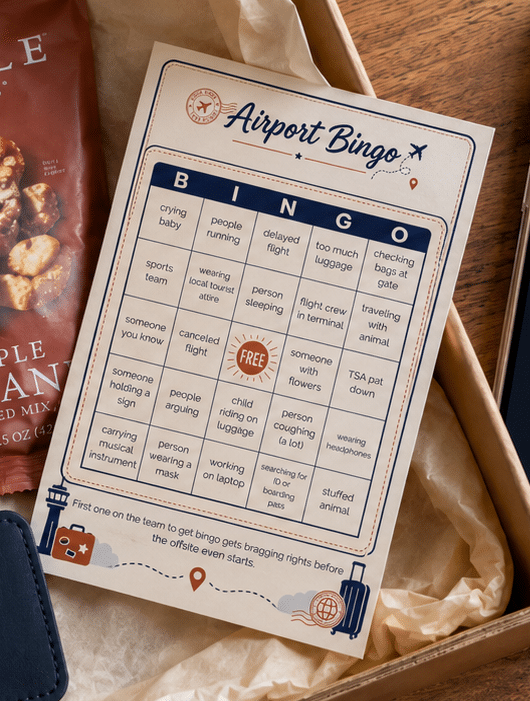
Here’s where it gets interesting. Tuck a travel bingo card in there, where squares include things like “someone on your flight is watching a movie you’ve also seen” or “you find a charging port that actually works.” Tell people to post in Slack when they get bingo. Now you have a team competing with each other, laughing about their travel days, and showing up already connected before they’re in the same room. The sales team just hit bingo. Operations is a “person reading an actual newspaper” away from winning. The Slack thread has fourteen replies.
That part didn’t cost you $2,500 a head. It cost you almost nothing. But what it bought is a team that arrived energized instead of drained, already sharing a story, already in it together.
Planning an offsite?
We made you something.
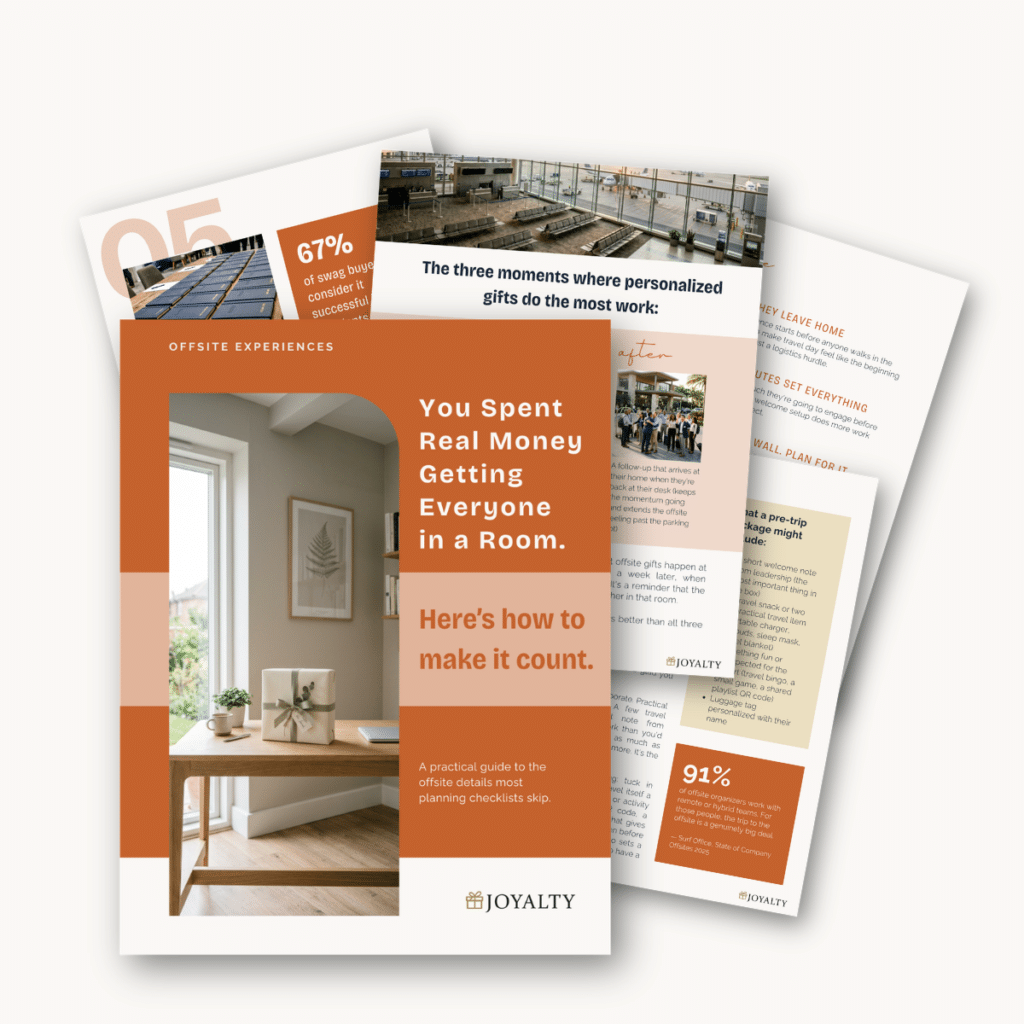
The Joyalty Offsite Experience Guide covers everything from pre-trip packages to what happens after everyone goes home, including timing checklists, welcome setup ideas, and how to keep the momentum going once the event is over.
What this has to do with ROI
The business case for offsites is real. High-performing companies run more of them and have the engagement numbers to show for it. 85% of employees say offsites strengthened their connection to their organization and its goals. The investment is going up across the board because companies are figuring out that getting people in a room, done well, actually works.
Done well is the variable.
The strategy sessions and planning conversations are the whole point. Nobody is arguing that a luggage tag is more important than a good Q3 planning session. But engagement in those sessions doesn’t start when the first slide goes up. It starts on the travel day. It starts when someone opens something in their mailbox a week before and thinks: they actually thought about me going on this trip.
People who arrive already bought in participate differently than people who arrive as an audience. They ask better questions. They contribute more honestly. They leave with a sense of ownership over what was decided, instead of a sense of having sat through it.
That’s what the pre-trip package and the airport bingo card are actually doing. They’re the difference between running a presentation and running an offsite.
The other side of the number
You’re going to spend the $2,500 either way. The venue is booked. The flights are purchased. The catering minimum is non-negotiable.
The question is whether you spend a little more to make sure that investment actually lands, or whether you leave the most controllable variable entirely to chance.
People should leave an offsite wanting to get back to their desks. Not relieved it’s over. There’s a measurable difference between those two outcomes, and it shows up in how the next six months go, in retention numbers, in the energy of the team when you start planning the next one.
The agenda gets people in the room. The details determine what they do with it.
When you’re ready to put something together for your team, we’d love to help.
Frequently Asked Questions
The questions we get a lot.
What are good gifts for a company offsite or retreat?
The best offsite gifts are practical, personal, and tied to the moment. For travel days, that means things like a portable charger, a good snack, a travel blanket, and a luggage tag with their name on it. For the welcome setup at the event itself, a personalized notebook, a quality pen, and a water bottle with their name on it go a long way. The key difference between a gift that lands and one that gets left in the hotel room is personalization. Something with someone’s name on it communicates that the company thought about a person, not a headcount. We work with companies to build out the full experience, from the pre-trip package to what happens at the event and after. If you’ve got an offsite coming up, we’d love to help you put something together.
How much should I budget for company offsite gifts?
It depends on how much of the experience you want to cover. A pre-trip package with two or three practical travel items, a personalized luggage tag, and a note from leadership typically runs $50 to $75 per person once you factor in items, personalization, and shipping. An on-site welcome setup (personalized notebook, water bottle, welcome card, one unexpected item) runs similarly. If you’re doing both, budget $100 to $150 per person and you’ll have something genuinely memorable at each touchpoint. For leadership retreats or milestone events, $150 to $200 per person gives you room for premium items and more elevated presentation. The number worth keeping in mind: you’ve already spent $1,500 to $3,000 per person to get everyone in the room. The gifts are a small fraction of that and often the part people remember longest.
Should I do offsite gifts for a small team?
Yes, and the case for it actually gets stronger with smaller teams. In a room of twelve people, each individual’s engagement level has a bigger impact on the room than it does in a room of two hundred. A pre-trip package for a leadership offsite or small team retreat signals that the company specifically wanted each of those people there, which matters more when everyone knows each other well enough to notice the difference. Small doesn’t mean low-stakes. It often means the opposite.
Do personalized offsite gifts actually make a difference?
The practical case is stronger than the sentimental one. Personalized items don’t get mixed up, left behind, or end up in the hotel lost-and-found. They also communicate something a generic branded item doesn’t: that someone thought about the individual, not just the group. In a room of identical items, the one with your name on it sends a different message than the others. Employees notice even when they can’t articulate exactly why.
Where can I get personalized gifts for a company offsite?
That’s us. Joyalty builds done-for-you offsite gift programs for companies with 50 to 300 employees, including pre-trip packages, on-site welcome setups, and post-event gifts. We handle sourcing, personalization (engraving, embroidery, custom printing), and logistics so you’re not tracking down twelve different vendors six weeks before your event. Tell us your event date and headcount and we’ll put something together for you.
When should I order offsite gifts?
Six weeks before the event is the minimum for anything personalized. Eight weeks is better. For pre-trip packages that need to arrive at employees’ homes before travel day, you’ll need confirmed headcounts and home shipping addresses at least two weeks before the ship date, which means starting the process earlier than that. Most people start thinking about offsite gifts two weeks out. That’s not enough runway to do it well, and it’s usually when the shortcuts happen.
Ready when you are
Let's design something your team will remember.
We handle everything. You take the credit for being the company people stay at.