
Employee Retention
Employee Engagement Fell 24 Points in One Year. Here's What HR Leaders Are Being Asked to Fix.
If you run the people org somewhere right now, you have probably already seen the number in your own survey data. Engagement is down pretty substantially. And I’m guessing that you’ve seen a drop at your company, too.

You have probably already had the big leadership meeting. The one where the engagement scores are brought up and then everyone in the meeting looks at you. They ask what you are going to do about it. (Because it is obviously HR’s problem to fix. Certainly not an overall leadership issue. Right?)
How do you eat an elephant? One bite at a time. Same thing here. Figure out what is actually going on, then start tackling the parts you can control, one at a time.
So what’s likely going on? A few things are stacking on top of each other. Burnout is at its highest level since the early pandemic. A lot of people are staying in jobs they have mentally checked out of (that whole “quiet quitting” thing). They are too scared of the market to walk out of a stable job. And the managers who are supposed to make work feel human are the most overwhelmed group in the building. Put it together and you get people who show up, do the minimum, and plan their exit on the side.
Now that you know the main contributors, let’s talk a bit about the part that falls on your shoulders.
64%
Employee engagement among white-collar professionals fell from 88% to 64% in a single year.
The numbers you are being asked to explain
You’ve pulled all the reports and shared them with leadership. And now they want you to explain what is happening. “Is it just us?” “How bad is it?” “Is there anything we can do?” “How much is this costing us in lost productivity?”
Here is the wider picture across the board.
20%
Only 20% of employees worldwide are engaged, the second straight year of decline. It is the first time Gallup has ever recorded two consecutive drops.
55%
55% of US workers are experiencing burnout, the highest level since the early pandemic.
6 in 10
Nearly 6 in 10 US workers say they are staying in their current role out of fear, not loyalty.
Read those together and you get a workforce that is tired, stuck, and one good offer away from leaving. That last one is the sneaky stat. “Well, at least retention is stable.” Not so fast. A low turnover number looks like stability on a dashboard, but a lot of the time it is just fear. The people are still at their desks. They already left in every way that matters.
A low turnover number can look like stability when it is really just fear.
So what is actually driving it?
Quick definition first, because “engagement” gets thrown around until it stops meaning anything. Engagement is not happiness. (Someone can be super happy because they just don’t care anymore. Doesn’t make them engaged at work.) Engagement is whether people are actually invested in their work or just present for it. You can have a full office and almost no engagement.
Three forces are pulling the number down.
- Burnout is the first, and it is one of the clearest early signals that someone is already planning their exit.
- The second is the fear-based staying we just covered, which hides the problem instead of solving it.
- The third is the one nobody likes to say out loud: the managers who are supposed to deliver recognition are running on empty themselves.
80%
80% of HR leaders say their managers are overwhelmed by the expanding scope of their responsibilities.
Here’s how it looks on the ground. Layoffs happen, or maybe just normal attrition, and the people left behind are asked to pick up a bit more work. Their scope increases, but their pay doesn’t. And even a simple thank-you gets missed, because the manager is just as overwhelmed. This person is frustrated because they feel like they’re working their butt off and nobody even notices. And they’d walk out today if it weren’t such a rough job market right now. So they don’t leave, but they aren’t fully there either. I’m willing to bet you can name at least a couple people on your team (maybe more) who fit that scenario to a tee.
Nobody is trying to suck. They’re just busy. They prioritize deliverables and figure that the team will understand.
Here is the part that lands on your desk
We all know we’re supposed to focus on the things we can control and not what we can’t. The part of this problem that you own is the piece employees feel most: whether they are treated like people who matter or line items who perform. The managers are responsible for the acknowledgements of a job well-done, but you are responsible for the systematic employee appreciation and engagement process.
That distinction matters. HR people tend to be process-oriented, so I feel like I’m talking to my people here, but appreciation has got to be a structured process. If not, it is inconsistent and the team members don’t feel it, or worse, the team feels it unequally.
45%
Employees who get high-quality recognition are 45% less likely to have left two years later.
The stat above doesn’t say “pay them more.” (Though pay is important and you should absolutely pay people fairly. That’s a related, but separate conversation.) What the stat does say is that people will stay longer if they get high-quality recognition. High-quality doesn’t need to be expensive. It just needs to be intentional. Seriously. We send gifts of all sizes (varied to keep the ‘surprise and delight’ vibe throughout the year). Some of the most meaningful gifts are the small gifts with a handwritten note. Doesn’t cost a lot, but sure makes people feel special.
Before starting Joyalty, I used to work for one of the largest marketing agencies in the world (with over 65k employees globally in the network). Think about that. 65k people is almost enough to fill NRG Stadium at capacity. Now imagine greeting each person by name and thanking them for the work they do on the Marketing or Engineering team as they walk in. It is hard to make people feel special and seen at those volumes.
But at 50 employees, you can do it. In fact, y’all are probably hanging out together on weekends. At 300, it is a bit more difficult, but the entry level developer can still joke around with the CEO in the break room and nobody thinks anything of it. At 65k, the CEO is calling security on you if you approach too quickly. (I’m not going to get into how I know that.)
If you are with a company with a few hundred people or fewer, you have a huge advantage that the big companies don’t. And all you have to do is be intentional. That’s it. That’s how you win. Be intentional about respecting your people. Be intentional about recognizing their contributions. Be intentional about honoring the things that matter to them. Be intentional about appreciating them and the work they do.
So what are you going to do about it?
The honest answer for most companies is that appreciation is not a program. It isn’t systematic. Instead, it is a few nice things that are done when someone remembers. (Or a P2P system where employees recognize each other and leadership washes their hands of it. But that is going to be a later post.)
This is not complicated, but it does have to be built on purpose.
- Consistent, so it does not ride on one manager’s memory or one good week.
- Specific, so it feels like it was meant for the person and not printed in bulk.
- Regular, so people feel valued in March, not just at the holiday party.
That is what this series is about.
This is the first of eight posts on why engagement keeps falling and what actually moves it back. Over the next several weeks we are going to take apart the recognition gap one piece at a time: what employees actually respond to, why platforms and points miss, and how to make the business case for an appreciation budget when the answer from finance is usually “not this year.”
If you would rather have the whole argument in one place, we pulled it together into a free guide for HR leaders.
Appreciation shouldn't be whoever remembers, doing something nice when they have a spare minute.
01 of 8 in the series
This is the first of eight posts on why engagement keeps falling and what actually moves it back. Over the next several weeks we are going to take apart the recognition gap one piece at a time:
What employees actually respond to
Why platforms and points miss
How to make the business case for an appreciation budget when the answer from finance is usually “not this year”
Want the whole argument in one place?
We put it in a guide.
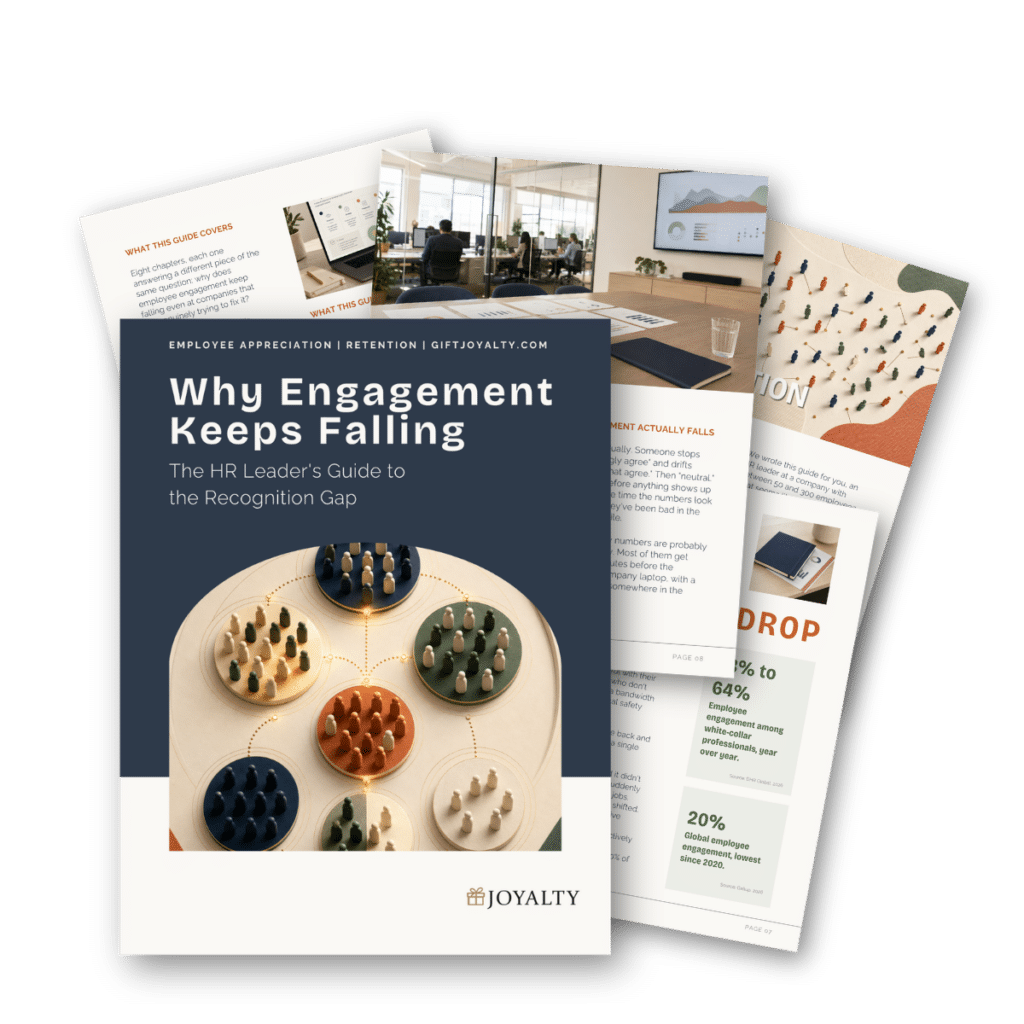
Why Engagement Keeps Falling is the HR leader’s guide to engagement problems, covering the three forces driving disengagement, what the data says about recognition and retention, and how to make the business case when finance says “not this year.”
Frequently Asked Questions
The questions we get a lot.
Why is employee engagement declining in 2026?
Three drivers are stacking up: burnout is at its highest level since the early pandemic, many workers are staying in jobs out of fear rather than loyalty (which masks disengagement), and the managers responsible for recognition are stretched too thin to deliver it. Engagement measures whether people are invested in their work, and all three forces pull that investment down.
Is engagement the same thing as employee happiness?
No. Happiness is a mood; engagement is investment. Someone can be perfectly pleasant, stay for years, and still be disengaged (present, but coasting). That is why engagement scores and retention numbers can both look fine while the actual energy in the building drains out.
Is low engagement really HR's problem to fix?
HR cannot fix the economy or a company-wide burnout crisis alone. But the piece HR most directly influences, whether people feel valued rather than evaluated, is exactly the piece that drives whether they stay. That makes it the highest-leverage place to start.
Does recognition actually affect retention, or is that just a nice idea?
It affects retention, and the data is strong. Employees who receive high-quality recognition are 45% less likely to have turned over two years later (Gallup and Workhuman, 2024). The catch is that it has to be consistent and genuine, not a once-a-year gesture.
Ready when you are
Let's design something your team will remember.
We handle everything. You take the credit for being the company people stay at.