
Employee Onboarding
What a New Employee Welcome Gift Should Actually Look Like
Day One is the most important moment you have with a new hire. Here’s what should be in the box and why each piece matters more than you think.
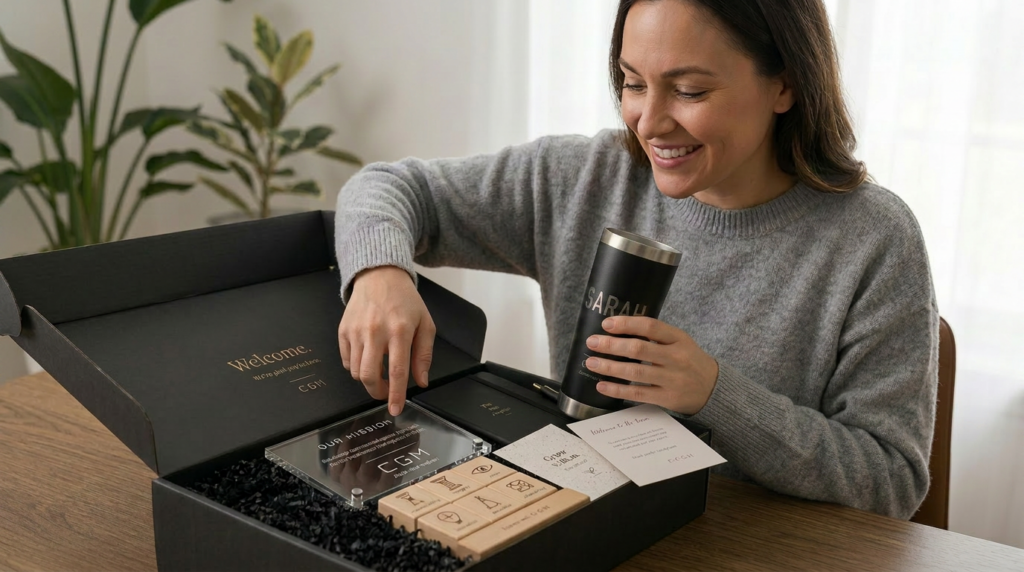
Day One at a new job is a special kind of chaos.
Employees are learning new software while pretending they already get it. They’re meeting people whose names they will blank on two minutes later. They’re figuring out unwritten rules that everyone else treats as obvious. They’re smiling a lot. Like, a lot a lot. Their face hurts.
And underneath all of it, one thought is running on a loop: did I make the right move?
People don’t like change. They tolerate it when they have to, they choose it when they’re brave, and then they spend the next 30 days wondering if they made the right decision. Switching jobs is one of the biggest changes a person makes. New company, new coworkers, new expectations, possibly a new industry. For remote employees it’s even stranger, because they’re doing all of this from a makeshift office in a spare bedroom, alone, with their dog staring at them during their sixth Zoom call of the day.
The question they’re really asking isn’t about login credentials or where to find the shared drive. It’s simpler and scarier than that: “Have I made a mistake?”
Everything that happens in those first few weeks is evidence for or against that verdict. The manager who actually shows up for them. The team that already has lunch on the calendar. The 90-day plan that exists in writing before they start. All of it adds up. And here’s where most companies blow it: instead of reassuring people in that moment, they hand their new hire a laptop that they’ll inevitably have trouble logging into and say “let us know if you need anything.”
That’s not onboarding. That’s a trust fall where nobody’s planning to catch them, which is crazy given how much time and effort went into recruiting them.
Belonging doesn’t happen on its own. It’s not a culture thing. It’s not a ping pong table or free snacks thing. It’s an intentional decision to make people feel like they landed somewhere real.
The clock starts the second they accept the offer. What does that experience look like at your company?
One of the most underestimated moments in that window is the welcome gift. Not because a gift is magic, but because of what it communicates before anyone says a word. A welcome gift is the first physical thing a new employee receives from you. It arrives before the first meeting, before the first awkward “tell us about yourself” is answered, before they’ve done a single thing to earn anything. That timing is the whole point. You’re not rewarding performance. You’re saying “we thought about you before you got here.” That’s a completely different message than a stress ball with a logo tossed in a backpack.
We’ve spent a lot of time figuring out what goes into a box that actually says something worth saying. So let’s walk through it.
What goes in the box
What We Put In Our Boxes… And Why You Should Care
Most onboarding gifts are basically a company saying “here’s a backpack so you remember our name.” Cool. Very meaningful. Really sets the tone for the next decade of someone’s career.
Our boxes aren’t swag. They’re a statement.
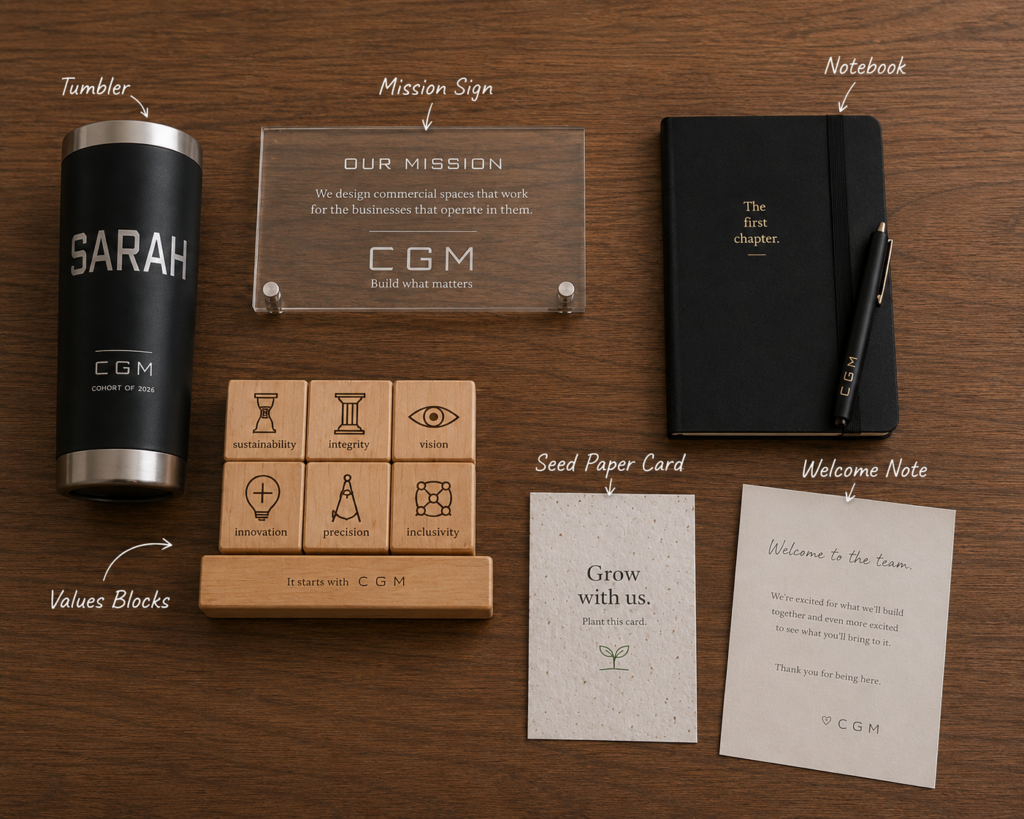
The tumbler
Yes, there’s a tumbler in most of our onboarding boxes. And yes, everyone does tumblers. But stay with us. The difference between a welcome gift and a “throw it in with the others” addition is quality. A well-made tumbler someone uses every single morning becomes part of their routine for years. Your brand is in their hand while they’re waking up, while they’re getting ready to start their workday, while they’re just existing. That’s not a small thing. A cheap one ends up in the back corner of a cabinet and takes your reputation with it.
Acknowledge the moment
Our notebooks say “Your first chapter.” on the cover. Not the company tagline. Not a logo in a corner. Just a simple, honest acknowledgment that something real is starting. Because it is. The person sitting on that Zoom call, sharing the dreaded fun fact about themselves and wondering if they made the right call… they’re starting something. Acknowledging that directly, in their hands, before they’ve done a single thing for you yet, is not a small gesture.
Reinforce your mission
An engraved desk sign with your company’s mission statement sounds like it could be deeply corporate and eye-roll-worthy. It’s not, and here’s why: most employees couldn’t tell you their company’s mission on a random Tuesday. Not because they don’t care, but because nobody ever handed it to them in a way that felt like it mattered.
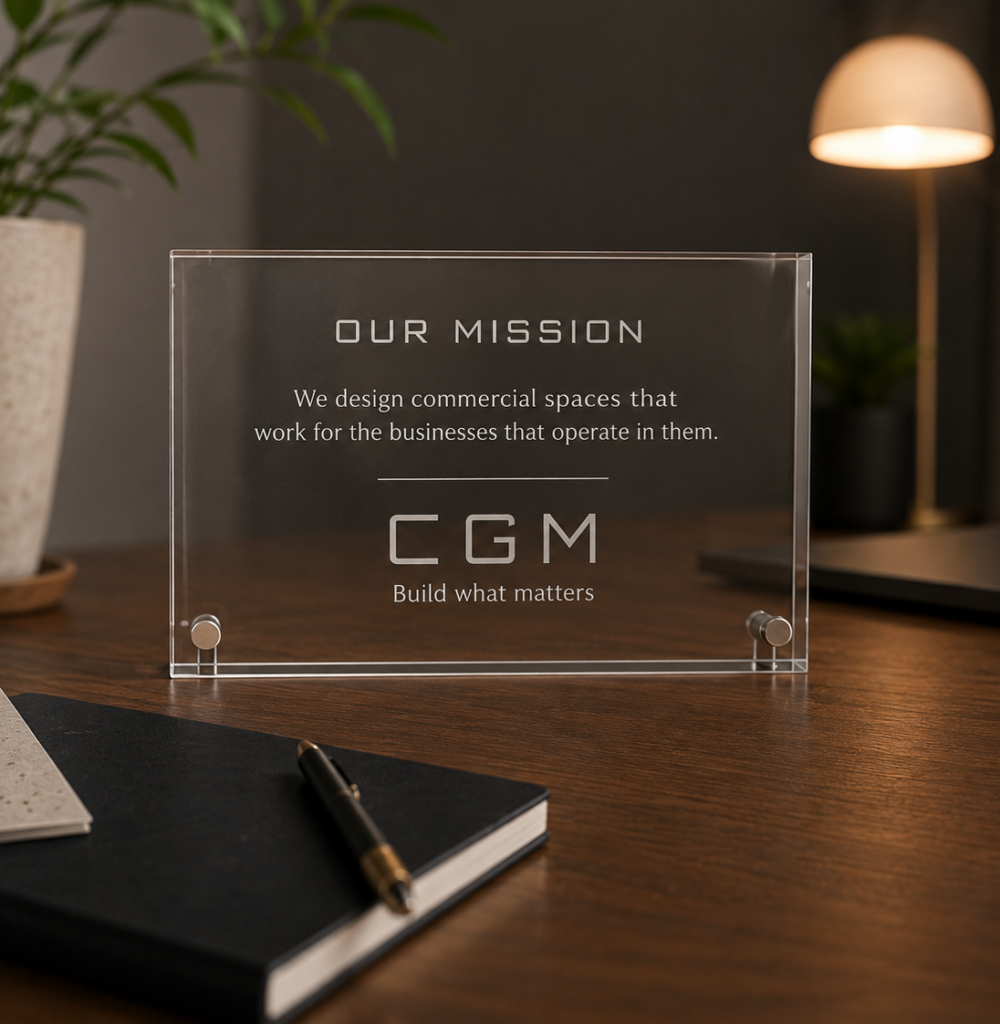
Burying it in a slide deck alongside seventeen other things to memorize on Day One is not the same as presenting it as a real and meaningful guiding principle. Putting it on a desk sign says it matters to you, which means it’ll start to matter to them.
Make your values tangible
Values are the building blocks of your culture. We’ve taken that a little literally. Culture is mostly invisible until someone makes it physical. Handing someone a set of engraved wooden blocks representing what the company actually stands for does something a values page on the website never could. It makes the culture feel real before they’ve had a chance to experience it firsthand.
The card you can plant
This one gets people every time. It’s a card printed on real seed paper that says “Grow with us.” You plant it in soil and something actually grows. Is it an on-the-nose metaphor? Sure. Is it also a genuinely lovely thing to send someone on their first day? We’d argue it’s the latter. When someone holds that card on their first day, they’re being invited into something. That’s different from being processed into something.
A note that sounds like a person wrote it
It looks handwritten with a real pen. (We have a machine that does that. No laser or inkjet printing. A real pen!) We’re telling you that upfront because pretending otherwise would be weird. But the words are real and the message is specific: we’re excited about what you’re going to bring here. Not “welcome to the family” (please stop saying that). Not a mail merge with their name dropped in. An actual warm, direct message that says somebody noticed this person was coming and was genuinely glad about it.
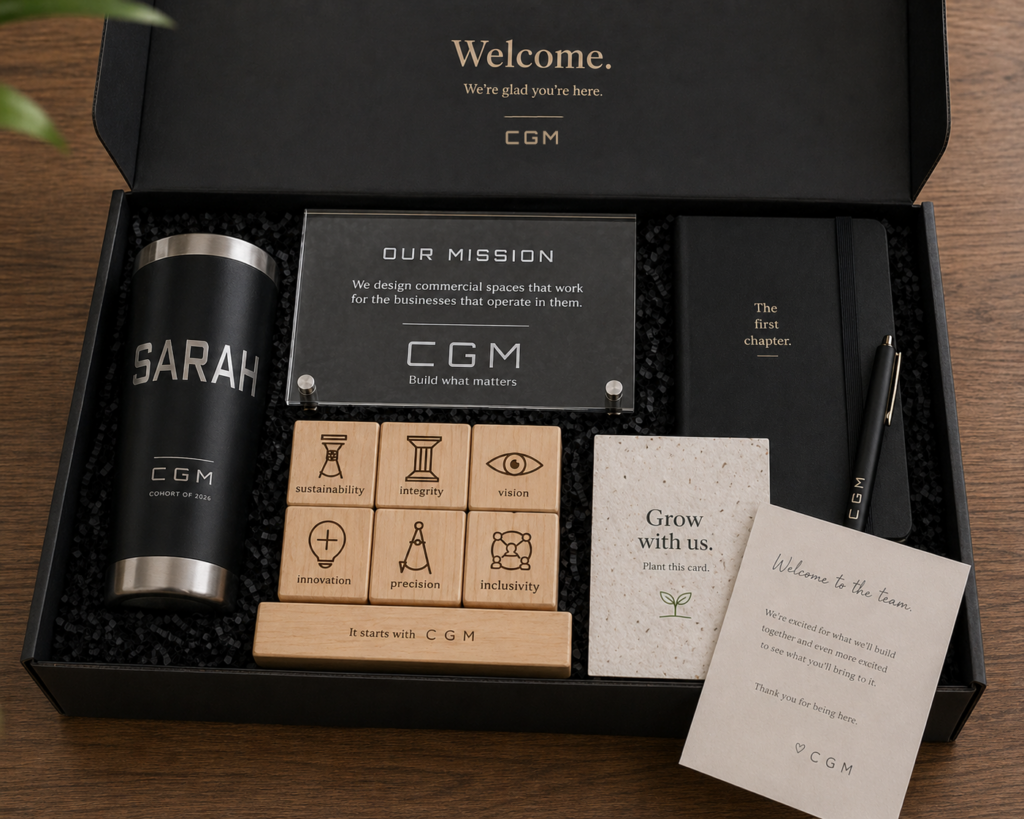
The whole box is built around one idea: belonging doesn’t happen by accident. It happens when someone on the other side of the relationship does the work to make you feel like you landed somewhere real.
None of this requires working with us. Seriously, it doesn’t. (But obviously we want you to work with us. That’s why we’re here.)
If you take nothing else away, take the framework: every piece of a welcome experience should answer “did I make the right call?” in some small way. The setup that’s ready when they start. The manager who was expecting them. The note from the team. The plan that exists before they ask for it. All of it tells the same story: this company thought about them before they showed up.
The companies that get retention right aren’t doing anything magical. They just decided early on that making people feel like they belong was worth the effort and then they were consistent about it.
People don’t leave companies. They leave the feeling that nobody noticed them. That feeling starts forming earlier than most managers realize, and it’s a lot harder to fix than it is to prevent.
Day One is not too early to start. It’s probably the most important time to start. First impressions, and all that.
Frequently Asked Questions
The questions we get a lot.
What should be in a new employee welcome gift box?
Anything that answers the question “did they actually think about me, or did someone just grab whatever was in the supply closet?” Practically speaking: something they’ll use every day, something that tells them who you are as a company, and something that acknowledges that starting a new job is a big deal. A quality tumbler, a notebook that says something real on the cover, your mission and values in a form that doesn’t disappear into a slide deck. That’s the baseline. The goal isn’t to impress them with the dollar amount. It’s to make them feel like someone was counting down to their start date too.
Do welcome gifts actually improve employee retention?
Yes, and the numbers are almost embarrassingly clear on this. Companies with strong onboarding programs see over 50% better retention rates. Employees who feel genuinely welcomed are significantly more likely to still be with you three years later. None of this is magic. It’s just what happens when people feel like they matter before they’ve done anything to earn it yet. The gift isn’t the whole answer. But it’s the first answer. And first answers set the tone for everything that follows.
Should you send a welcome gift before the first day or on it?
Before. Always before. On Day One, your new hire is already overwhelmed. New systems, new faces, new everything. A gift that arrives at their house before they’ve even logged in for the first time hits completely differently. It says “we were thinking about you before you got here.” If the box shows up on their desk Day One, fine. But if it’s waiting at their door before Day One? That’s the one they’ll remember.
What's the difference between a welcome kit and a swag bag?
Intent. A swag bag is what you get at a conference for showing up. A welcome kit is what you get because someone decided you were worth the effort. Swag says “here’s stuff with our logo on it.” A welcome kit says “here’s who we are, here’s what we believe, and we’re glad you’re here.” One ends up in a drawer. The other ends up on a desk for three years.
How much should a company spend on a new hire welcome gift?
Less than one month of a bad hire costs you. Which, for context, is a lot. Turnover is expensive in ways that are genuinely hard to calculate: recruiting fees, training time, lost productivity, team morale. A welcome gift that makes someone feel genuinely valued from Day One isn’t a line item. It’s an investment with a return you can actually measure in retention. Spend enough to do it right. The sweet spot is “wow, they really thought about this,” not “wow, how much did this cost?”
Ready when you are
Let's design something your team will remember.
We handle everything. You take the credit for being the company people stay at.